Plate readoutVIN source:
GET /v1.1/decode_vinMODEL YEAR —
Decoded vehicle
—
—MPG city
—MPG highway
- Engine
- —
- Transmission
- —
- Drive
- —
- Fuel
- —
- Tank
- —
- Seating
- —
- Steering
- —
- Brakes
- —
- L × W × H
- —
Plate lookup · New Hampshire
Enter a New Hampshire plate to find the vehicle's VIN, then decode it into year, make, model and factory specs.
GET /v1.1/decode_vinMODEL YEAR —
—
If you’re planning to purchase a car in New Hampshire, remember that you must register it with the New Hampshire Division of Motor Vehicles (DMV) before you can drive it on state roads. Upon registration, you’ll receive a registration certificate and your vehicle’s license plates. Still considering options? Be sure to take advantage of VinFreeCheck’s free services.
Did you know that New Hampshire is one of the few states in the U.S. that does not mandate car insurance? While it’s highly recommended to have auto insurance for financial security in case of an accident, it’s not legally required in the state as long as you can prove you’re capable of covering any costs of an accident for which you might be responsible. This makes New Hampshire quite unique in its approach to car ownership and liability!
New Hampshire is a two-plate state for most vehicles. Only bikes, trailers and trucks require rear plates. With that being said, your license plates can be found mounted on the front and back of your car. The license plate number is seven digits long, written in big, bold fonts, and is clearly visible.
You can also find the license plate number written on your registration certificate.
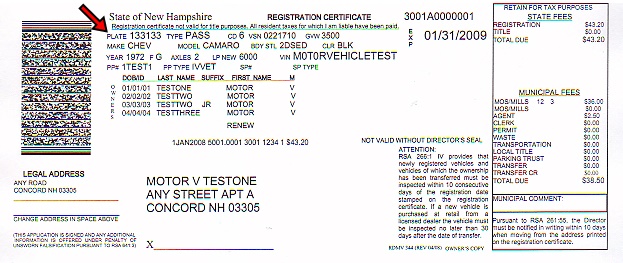
You’ll find your license plate number on your New Hampshire Registration Card
In New Hampshire, obtaining license plates for your car involves some steps that might differ than other states. You will first receive a temporary license plate, valid for 20 days, to allow you time to complete the registration process.
If you purchase your vehicle from a dealership in New Hampshire, the dealership will provide you with the temporary plate. However, if you buy the car through a private sale, you’ll need to obtain a temporary plate from the town clerk’s office.
Non-residents purchasing a vehicle in New Hampshire will require a 20-day in-transit temporary plate to legally drive the vehicle back to their home state.
For the registration process, you may need to present several documents, including:
The fees for registration can vary based on specific circumstances, and you can find more detailed information on the DMV’s website.
New residents have 60 days to register their vehicle and obtain a New Hampshire driver’s license. This may involve submitting additional documentation such as the vehicle title and paying any necessary registration fees.
New Hampshire offers several types of license plates, including:
Standard plates use the “Old Man of the Mountain” design.
Decal plates are similar to the standard plates, but have a 3”x3” blank square on the left side of the plate. You can place a special decal issued by any 501(c)(3) organization authorized by the state; these decals can be purchased from their respective organizations for a small sum.
Vanity plates are “personalized registration plate composed entirely of alpha characters, alpha numerical characters or a combination of symbols and alpha numerical characters.” You’ll need to pay specific fees depending on the choice of plate, and must abide by the state’s rules on what can and can’t be printed on the vanity plate.
Veteran Plates are issued to vehicles owned by veterans of US military service, as well as those who served in a military service of “any nation allied with the United States during World War II” (where proof is provided).
Specialty Plates offered by the state include the Conservation plate (with a moose on the left of the plate); the State Parks plate (with the State Parks logo on the left side); and the Conservation Parks plate. The last two plates allow entry into most New Hampshire state parks.
state=NH; get the VIN backimport os, requests r = requests.post( "https://vindecoder.p.rapidapi.com/api/v4/decode_plate", data={"plate": "<plate>", "state": "NH"}, headers={ "X-RapidAPI-Key": os.environ["RAPIDAPI_KEY"], "X-RapidAPI-Host": "vindecoder.p.rapidapi.com", }, timeout=10, ) vin = r.json()["data"]["vin"]
const res = await fetch("https://vindecoder.p.rapidapi.com/api/v4/decode_plate", {
  method: "POST",
  headers: {
    "X-RapidAPI-Key": process.env.RAPIDAPI_KEY,
    "X-RapidAPI-Host": "vindecoder.p.rapidapi.com",
  },
  body: new URLSearchParams({ plate: "<plate>", state: "NH" }),
});
const data = await res.json();
if (data.success) console.log(data.data.vin);
curl -X POST "https://vindecoder.p.rapidapi.com/api/v4/decode_plate" \
  --data-urlencode "plate=<plate>" \
  --data "state=NH" \
  -H "X-RapidAPI-Key: $RAPIDAPI_KEY" \
  -H "X-RapidAPI-Host: vindecoder.p.rapidapi.com"
Subscribe on RapidAPI, copy your key, make the call. Upgrade to PRO or ULTRA there when you need more.